
 Reading Time: 4 minutes
This isn’t my routine content type and there’s a change in how we deliver UI and UX design and engineering. Our hiring and talent deployment strategies need reconsidering against a lemming-like dive toward our boardrooms’ AI-assisted lay-off culture.
In my previous post, Losing the Joy of Tech Work, I wrote about the human cost of the current AI wave. You’ll recognise the loss of hands-on craft, the severance of our junior apprenticeship pipelines, and the quiet dread of relentless industry layoffs. Companies like Amazon, Meta, Pinterest, Block, and Intuit have tied job cuts to AI integration and smaller team efficiencies, even while posting strong revenue or planning doubled AI spending
When workers lose both intrinsic joy and job security, execution drops to baseline compliance—and eventually, our customers feel that disengagement in the product. I argued that local leadership needs to step up, protect creative problem-solving, and restore stability through meaningful commitments like 24-month contracts.
However, a recent BBC Global interview with economists Jerry Tucalis and Brett Folk suggests that asking corporate leaders for voluntary self-restraint might be fighting against economic gravity.
The BBC Global interview
The “AI Layoff Trap”
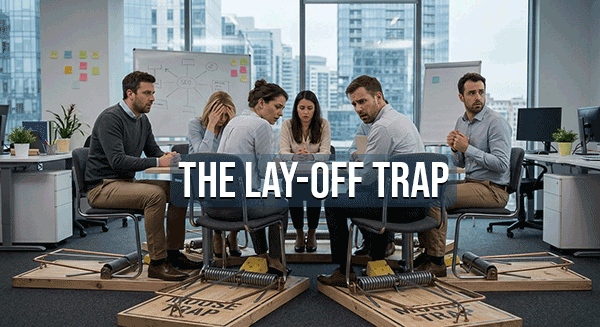
Jerry and Brett have modelled what they call the AI Layoff Trap as a classic Prisoner’s Dilemma playing out across the global tech sector.
The logic is that, when a CEO looks at autonomous AI agents, the immediate cost-benefit math seems obvious. Adoption can automate tasks, cut headcount, and slash operational expenses. The CEO recognises that mass layoffs across the economy will eventually destroy consumer spending power and leave fewer people to buy their products.
Yet, they can’t afford to do differently to the technology herd. If one company exercises restraint and its competitors aggressively automate, the restrained company risks higher costs leading to bankruptcy. In game theory, aggressive automation becomes a dominant strategy. Regardless of the collective cliff the industry is driving toward, every CEO is incentivised to accelerate AI adoption and resulting lay-offs.
Internal culture and external incentives
This economic reality creates tension with the workplace solutions I proposed in my earlier post:
- The cultural view (inside the building): To build accessible, human-centred products, teams need psychological safety, time to master their craft, and senior practitioners mentoring juniors.
- The market view (inside the boardroom): Shareholder pressure and competitive fear reward short-term margin growth over long-term human capability.
As Jerry points out, expecting companies to voluntarily tie themselves to the mast like Odysseus passing the Sirens is unrealistic when short-term survival is on the line. In their research, the economists argue that only external guardrails can change the math enough to stop the race to the bottom. Example guardrails include taxing full human-to-AI workforce replacements, or subsidising companies that retain staff.
Where does that leave us?
Policy changes and corporate taxation move slowly, if at all. Meanwhile, those of us building digital products by writing code, designing interfaces, or architecting content are living inside the Layoff trap right now.
Even if macro-economics forces executives toward automation, the teams that survive and build genuinely useful products won’t be the ones who replace human judgment with unchecked factory output. Until policy catches up with technology, the quiet rebellion for designers and engineers is to keep advocating for the user, keep mentoring the juniors around us, and refuse to let our craft be reduced to rubber-stamping AI automated mediocrity.
Hope and churn
A significant portion of leaders who rushed into AI-driven workforce cuts are now reported to experience pushback, lost institutional knowledge, and system failures. These impacts may lead to reversing course away from the Sirens and turn back to hiring human staff.
Fortune describes the reasons for re-hiring given by hiring managers in 2026 were:
- Lost institutional knowledge (40%): Automated systems lacked the undocumented context, nuance, and historical understanding that veteran staff carried.
- Client and relationship management (39%): AI tools struggled to maintain trust, empathy, and complex interpersonal relationships.
- Human oversight and quality control (38%): Rather than operating autonomously, AI outputs still needed heavy human intervention to catch errors and hallucinations.
- Premature cuts: Orgvue found that 23% of companies based their layoffs on broad assumptions about what AI might do rather than auditing what those specific roles actually required.
Are we wrong about the AI threat?
No, and there is a rebound.
Statistics from Google’s Gemini
There’s evidence that the AI-assisted lay-offs may exhibit a rebound: not to pre-AI levels, and a rebound of some degree up to around 30% or re-hired workers who were laid off:
- In 2026, Forrester and Orgvue find 55% of business leaders who made employees redundant due to AI deployment now admit they made the wrong decision.
- Fortune reports 32% of U.S. firms that eliminated roles to make way for AI tooling later reinstated the same or similar positions. I can imagine that includes content designers and technical writers!
- Research from talent firm SHL reported too, that 19% of the U.S. workers and 13% of UK workers they surveyed who were replaced by AI were then asked to return to their roles.
- Gartner even predicts that 30% of workers laid-off to make way for AI will be rehired — and no doubt at higher cost.
- Careminds found that 30.9% of companies spent more money rehiring and fixing issues than they originally saved through automation.
This is good news when your glass is half full, and not so good when the labour market is saturated with hundreds of thousands of people laid-off.
This laying-off and re-hiring of technology talent known as AI-rebounding can only introduce cross-pollination of experience, ideas, and skills. From a macro, helicopter-down viewpoint, this may be a healthy result for human-centred design process and progress. From a human viewpoint, while the AI Lay-off trap continues, our worker’s energy, loyalty, and trust may remain too damaged to recover and too expensive to value.
Worker backlash
There’s a backlash reported from returning workers. According to SHL’s research, workers invited back after being laid off for AI are demanding significant concessions:
- 51% demand a substantial pay increase to return. That’s great — if your role cohort is scarce.
- 42% require written guarantees regarding future job security. This relates to my concept of minimum contract lengths.
- 40% demand transparency into how AI will be deployed alongside their role. If the enterprise isn’t clear on their direction, this may not be available
When your mortgage and family health are severed, you’ll likely be glad of the job.
Bibliography
This is a list of links compiled from my chat with Google Gemini:
Author
Written with a ‘uman with ‘uman flaws and too little time to demonstrate them all.