
 Reading Time: 5 minutes
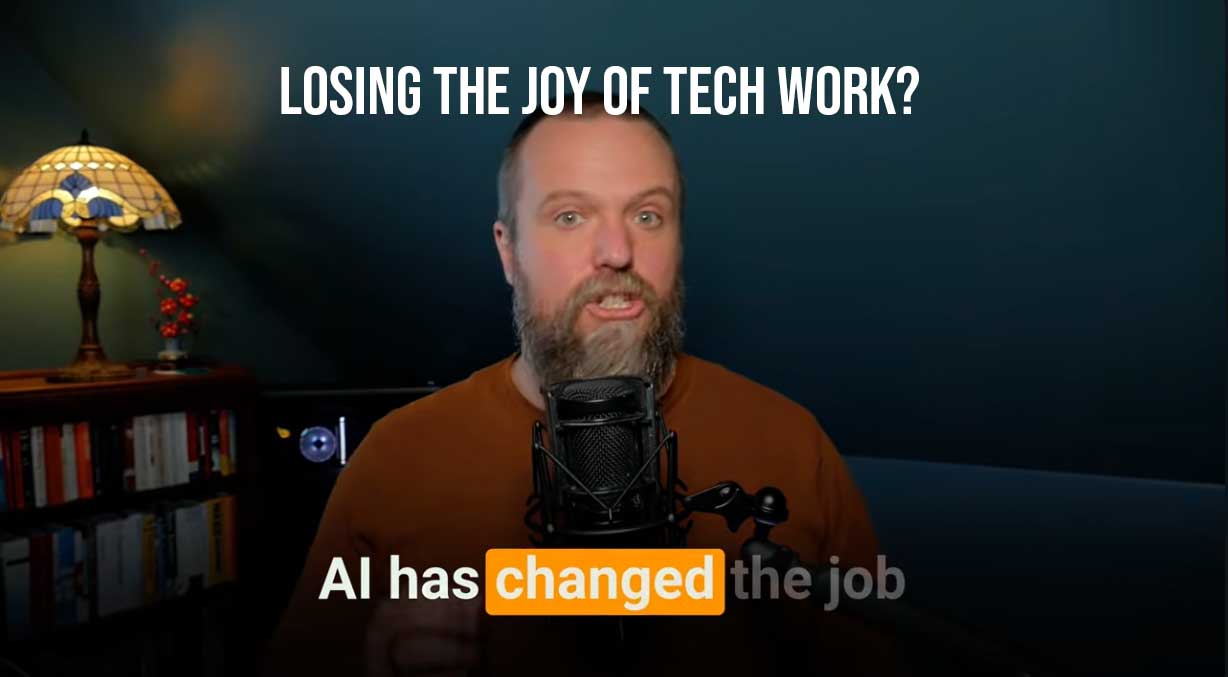
Michael Hoff describes how the joy is disappearing from our tech industry. In his YouTube video posted at the close of this post, Michael notes how the speed of change and learning is accelerated, and how we’re moving from problem solving into solution management with AI.
I reflect on this and babble on how AI adoption and associated layoffs are decaying worker engagement and even how AI risks running out of energy.
Michael’s engineering situation
Michael outlines his situation with AI tools as follows:
- Velocity of change. The shift from AI as a reactive “assistant” offering autocomplete and function writing to autonomous “agents” capable of exploring codebases, running tests, and debugging root causes independently, has happened in only months.
- Loss of hands-on craft. The mechanical joy of starting with a complex technical problem, manual problem-solving, and incrementally building an elegant solution is being replaced by needing to only supervise systems.
- The “Factory Floor Manager” Shift. Michael contrasts the old paradigm of a carpenter crafting furniture by hand with today’s managing a fully automated furniture factory. Engineers are now told to shift from pure execution toward product focus, system oversight, and business logic.
- Disengagement and career alienation. Highly skilled engineers who entered tech because they enjoy deep, hands-on technical problem-solving rather than product strategy or commercial outcomes, are leaving the industry. They haven’t lost their ability to adapt; they just don’t want the job that AI tools have adapted it into.
Relevancy to a UI or UX career
I can relate to Michael’s observations. I slid into content design work along a pathway of joy from teaching to e-learning design, and on to UI and then UX work. I enjoy solving usability problems and helping our users get on with our often complex and confusing systems.
Now, if LinkedIn is any form of career barometer, I’m steering toward agentic workflows and “vibe coding” poorer quality and faster-produced quantity over quality. Sure, AI tools get close to my craft and more quickly, and when I inspect their output today it falls well short of my own craft. The gap’s closing, and with business competing in a fast-paced race to domination, my future as a content designer is under imminent threat.
I relate to Michael’s analysis when he highlights a central paradox of the AI era. Craft and execution is being trivialised while high-level intent, systems thinking, and agentic direction is the actual work.
For a design leader specialising in accessibility, cognitive UX, and content architecture, this shift creates new dynamics:
Shifting from “maker” to “system architect”
Like engineers shift from manual coding to guiding agents, design workers are moving from flow and layouts to instructing LLMs and setting design tokens. We’re increasingly governing UI and content rules, and establishing mental models for the LLMs to work with. The craft isn’t disappeared yet, and it is abstracted. Soon, the LLM training will improve enough to take over our roles too. Who sets the human-in-the-middle guardrails then?
Content strategy and mental models are the new code
Michael notes that engineers forced to become product focused; defining what should be built and why. This is precisely where content design and UX architecture excel. AI agents can output screens or functions instantaneously, and they lack human context. They don’t quite understand user anxiety, cognitive load, semantic hierarchy, or accessible interaction patterns unless guided by explicit design mechanics.
Disengagement and the value of human craft
Michael’s concern about losing the “craft” of engineering applies to design. When generative tools produce instant wireframes or interface copy, organisations are tempted to treat design as a “factory floor”. Output is higher than quality, and if it’s good enough, then it ships.
However, the distinction between a working interface and an accessible, cognitive-friendly experience remains a human domain today. The challenge and the opportunity is ensuring that human expertise directs the system’s underlying logic rather than just auditing low-quality automated outputs.
Thinking about the long game
Protecting execution in the AI era doesn’t just mean adopting faster tools. It demands restoring meaning to the work and stability to the workplace and according to Michael’s story, it may be too late already.
As AI LLMs became mainstream, our conversations included forward thinking on what happens when the stewards and seniors govern LLMs and no longer have juniors. Apprenticeships are easily replaced by agentic tooling, so who learns to manage and govern each discipline without experiencing what the discipline is?
Additionally, as we work under the growing fear of being let go during the next organisational reorganisation organisation, trust in our employment is reduced. When we become less motivated to serve our employers and we lose the joy in our work, our execution can only suffer.
High-performance output relies on psychological foundations. Intrinsic joy in our craft and a basic sense of security are key. Today’s tech workforce faces an unprecedented erosion on both fronts. As AI agents reduce hands-on engagement with problem-solving to passive oversight, workers will lose the motivation that drives their passion. Concurrently, relentless industry layoffs have shattered any illusion of employer loyalty.
Combined, these two factors — AI adoption and layoffs — are destroying the psychological safety required for deep, innovative work. When a personal craft is automated and employment and benefits are perpetually precarious, motivation can only drop to the baseline of self-preservation.
The result is a dangerous drag on execution. Teams working under these pressures can stop taking creative risks. They can stop putting in the extra efforts their prior passions once drove.
AI under house arrest?
The tech sector is navigating an infrastructure wall where ecological constraints, regional political pushback, power shortages, and unsustainable capital expenditure (CapEx) are colliding.
Politically it’s now our AI under threat of ecological and financial realities. U.S. data centres currently consume roughly 180 to 200 Terawatt-hours (TWh) of electricity annually. That’s roughly double the annual domestic electricity consumption of all circa 28 million households in the United Kingdom combined (~95 TWh).
When the current tranche of data centers consume these quantities of power, imagine the power generation needed to feed U.S. plans for super intelligence growth. U.S. Department of Energy (DOE) and energy studies project that data centers will account for up to 25% of all new U.S. electricity demand by 2030.
At the same time, the Department of the Interior is opening federal public lands for long-term fair-market lease agreements to host large-scale AI data centres and co-located power stations. And this isn’t only a U.S. situation: China is a leader in the AI-race and there’s not a region in the World not signed up to AI growth.
If utility grid capacity runs out, developers must resort to complex “Bring-Your-Own-Power” (BYOP) arrangements and dedicated on-site microgrids. This raises the capital needed per megawatt and drives up the base price of AI computing. This can only raise token pricing.
Could AI become too expensive for the tech industry to sustain and return bodies to seats? Alternatively, will enterprise so desire an AI capability that they will layoff colleagues to off-set the costs?
Whatever is happening in this apparently fragile technology landscape, we likely need urgent action from local leadership to stop workers being so disengaged our customers feel it in the product.
Workplace solutions
There’s not a great deal an average enterprise can do to mitigate a possible geo-political AI storm and there’s possibly a lot they can do to “keep the lights on”. Layoffs seem the only page in the organisations playbook today, and that’s not creating a healthy work environment. Trust, loyalty, and growth are words of antiquity.
Executive leaderships and managers need to reassure their colleagues and support their passions, without which the product dries grey. Maybe it’s not a case of a changing workforce and relocating resources, and more an opportunity to change how we work.
For example, encouraging creativity and problem solving even when separate to production, bringing in and allowing juniors to learn how to complete the tasks AI is doing, and engaging workers on fix-term 24-month contracts to return even some job security. Maybe, just maybe then we can benefit from the efficiency of AI tooling and maintain the human gifts of love and passion our products need.
Meanwhile, 2026 continues its shock and awe with layoffs. The following is reported on November 11, 2026. Where’s the joy in this?
- Total Tech Layoffs: Between 135,000 and 200,000+ total tech workers laid off so far in 2026 across hundreds of companies.
- Pace: The rate of 2026 layoffs in 2026 has outpaced full-year totals from 2025!
Discover all the bad news at Layoffs.fyi.